Witness to our journey
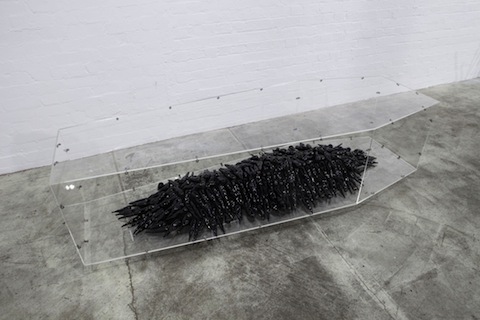
Yhonnie Scarce is an Australian artist specialising in glass-blowing. Since graduating from the South Australian School of Art in 2004 her work has given a voice to a number of Indigenous issues
Yhonnie Scarce is an Australian artist specialising in glass-blowing. Since graduating from the South Australian School of Art in 2004 her work has given a voice to a number of Indigenous issues

By Sienna Merope This article is part of our April & May focus on Art and Human Rights. Writing about the contribution of fashion to human rights can feel like a bit of an uphill battle. First, there is the not totally undeserved perception that as an industry and a creative practice, fashion has little […]
The Federal Government’s Creative Australia Policy was recently released by the outgoing Arts Minister Simon Crean, who came under fire for the use of the word “tolerance” in relation to people with a disability. This line has since been taken out but Arts Access Victoria has responded with dismay at the policy, not just for […]

Right Now kicked off the month of March with our sport and human rights theme. Paul Oliver explains how, contrary to what you might expect, sport and human rights are closely connected. He tells us why sport can be an effective tool to address discrimination, encourage respect, and promote social cohesion and equality. Marking Right […]

“I figured out that I was gay when I was about 12 or 13 years old,” Ball said. “I fought it for a very long time, and it took me quite a while to come to terms with it because I felt that I would be letting my … community down.” Jason developed his football […]
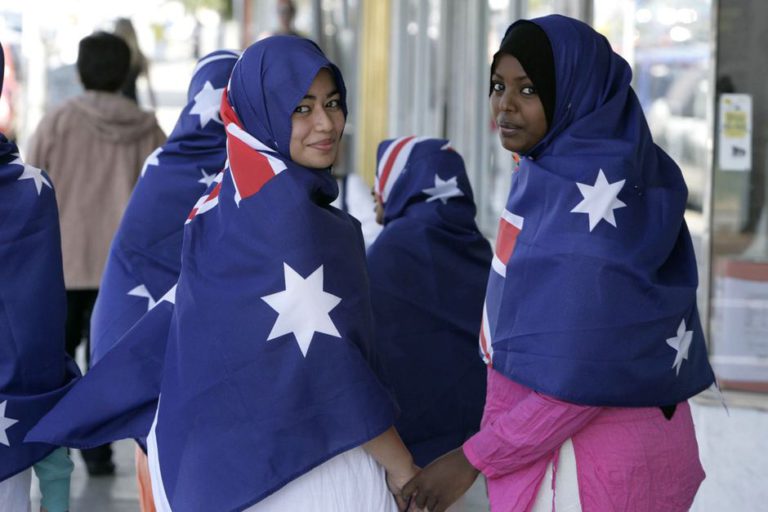
What do a conservative leader and a radical feminist have in common? More than we would have guessed, it seems.

By Paul Oliver. This article is part of our March theme, Sport and Human Rights. A coach has no access for her wheelchair to get into the local clubhouse. A spectator yells racist remarks at an Aboriginal player during a footy match. A team excludes a gay athlete from making the rep teams because it might […]
By James Petty. This article is part of a series on human rights and video games. In most reviews and critical examinations of video games, analysis tends to focus on a few specific elements of gaming: violence (how much and what kind), narrative (its quality and how it is delivered) and player experience (what it is […]

By Alana Lazdins. In his exhibition, My Dad the People Smuggler, Australian artist Phuong Ngo recounts through film, interview and photography the story of the Vietnamese diaspora caused by the military victory of the Vietnam People’s Army in Saigon, and the subsequent rise of communism in 1975. Ngo’s father helped refugees to flee communist Vietnam, […]

By Brendan Keogh. This article is part of a series on human rights and video games. Videogames are art. Anyone who says otherwise either doesn’t know what videogames are or they don’t know what art is. Videogames are creative works produced by creative people trying to express something. It’s that simple. Just like all forms of […]

By Benjamin Riley. This article is part of a series on human rights and video games. Like any artistic medium, video games have the capacity to engage us with the concerns of marginalised and persecuted people in the world. Of course, literature, visual art and theatre have been doing this for a long time. While […]
Video games are a massive part of Australian and international popular culture. In 2012, the industry recorded more than $1 billion in sales in Australia. According to a 2011 study of gamers between 18 and 40 years of age, around 2 years of a person’s life can be spent on gaming. Discussion of the impact […]