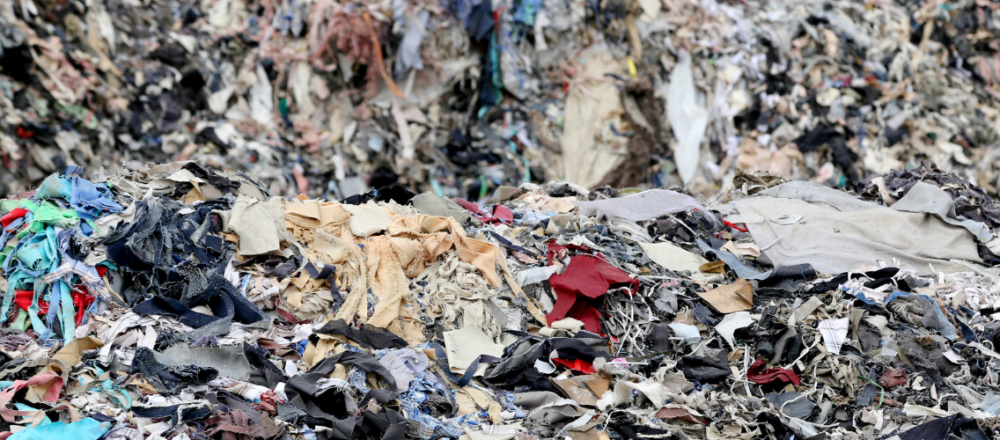
For decades, Fiji’s lucrative second-hand clothing market has offered affordable garments and a shot in the arm for the local economy, while easing the consciences of people in Australia cleaning out their closets.
But the growing influx of cheap clothing donated from wealthy countries is raising concerns about its eventual disposal and potential toxic pollution in Fiji, as well as undermining local garment manufacturing and the jobs that sector could offer.
Second-hand textile exports out of Global North countries to the Global South is often marketed as “upcycling”, persuading people donating unwanted clothing that they are doing something useful for the planet. But some experts and authorities describe it as waste colonisation, arguing the trade can be damaging, raising serious ethical and environmental concerns.
Landfill sites in Fiji have limited space and capacity for sorting materials, resulting in plastics and textiles being burnt together, presenting risks to air quality and waterways, says Permanent Secretary at Fiji’s Ministry of Environment, Dr Sivendra Michael.
“It’s a very big concern, given that we don’t have the necessary infrastructure and facilities to be able to recycle any form of disposed textile,” Michael tells Right Now.
Degrading clothing has a tremendous impact on the environment, he says, with chemicals, finishing agents, solvents and dyes potentially leaching into the local environment. Blended fabrics, zippers and buttons also need to be separated and disposed of through specialised textile recycling facilities.
There is an imperative to incorporate all stakeholders – from climate change activists, fashionistas, businesses and government officials – to get diverse perspectives and ensure everyone is on the same wavelength, Michael argues.
“I think instead of overburdening the local waste systems, they (producers and suppliers) should be able to take on board the ability to take back what is not used, that is going to be discarded,” he says.
There is also a need to educate consumers both in Fiji and abroad about upcycling and sourcing clothing responsibly, and to decolonise Pacific mindsets with regards to Western fashion trends that enable fast fashion companies to grow.
The problem of textile waste is rooted in colonisation, Michael says, whereby fast fashion with cheaper materials produced by poorly treated workers proliferate in communities where western fashion and trends are rife.
“Fashion is taking a very different pivot to the way fashion was perceived in the Pacific identity. For me, it’s a neoliberal construct of the way in which we are trying to define fashion.”
The Australia Institute’s director of circular economy and waste, Nina Gbor, also describes the market of donated clothing as “waste colonisation”, an inequitable practice akin to any others where wealthier nations export waste such as chemicals, plastic and electronics to countries in the Global South, including the Pacific.
“First of all, we should ban the export of textile waste, because if we did, that would force Australia to take accountability and responsibility for its waste,” argues Gbor.
Australia is one of the world’s leading consumers of textiles, with 1.4 billion units of new clothing entering the Australian market each year. Statistics from the Australia Institute show about 200,000 tonnes of these clothes end in landfills, while about 100,000 tonnes is usually shipped abroad.
In the case of Fiji, data from the country’s Ministry of Trade shows Fiji imported over $136 million of worn clothing and articles between 2010 and 2024, of which $128 million was imported from Australia. In Fiji, worn clothing imports increased from $5.8 million in 2010 to $11 million in 2024.
A report by the Observatory of Economic Complexity (OEC) calculated that Australia exported $68.1 million worth of used clothing in 2023, with Papua New Guinea and Fiji being its two major Pacific markets.
Textile waste has long been recognised as an urgent problem within Australia, with the Federal Government’s Standing Committee on Industry, Innovation, Science and Resources conducting an inquiry into waste management and recycling industries in 2019. In its report, it said there were arguments that clothing exports could be seen as a commodity rather than waste, one meeting needs of lower income individuals within Australia and other markets. Its recommendations did not discuss the possibility of a waste export ban.
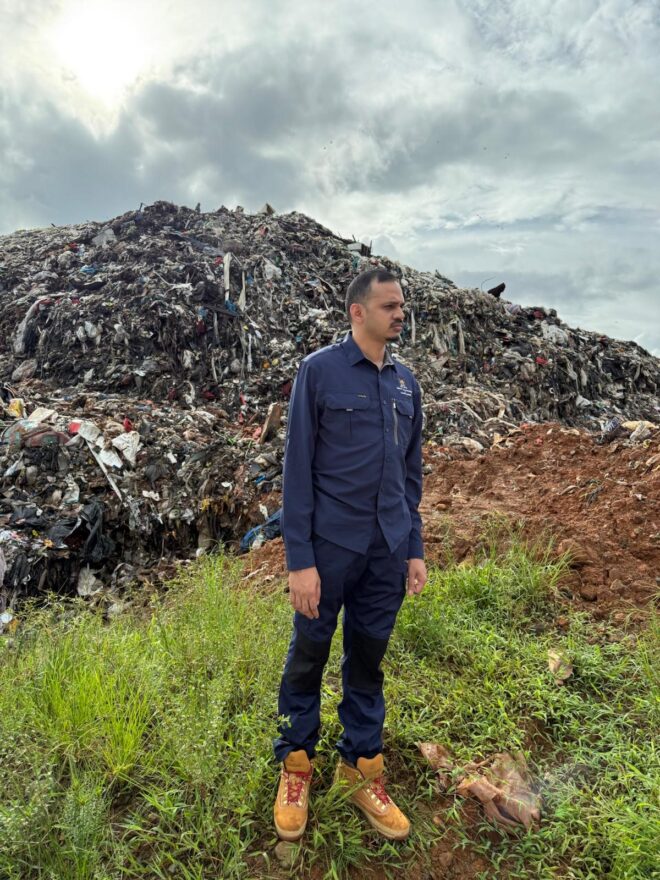
Image: Fiji’s permanent secretary for the Ministry of Environment and Climate Change Dr Sivendra Michael at a routine inspection at Naboro Landfill in Fiji earlier this year (Image: Supplied)
In 2024, the Australian Government announced an ambitious plan to reach a circular economy model by 2035, creating a closed-loop system within Australia where items are repaired, recycled and reused, minimising waste in the long term. The federally funded Seamless project doesn’t tackle the question of exported materials.
Victoria has meanwhile adopted its own circular model concept, with $630,000 invested in five projects to reduce textile waste by about 600 tonnes.
But Gbor cautions that the integrity of circular economy models requires further steps, such as governments taxing fast fashion brands, supporting reuse and recycling facilities through funding and tax incentives, and investing in sustainable clothing businesses.
She points out that in 2020, through the National Waste Action Plan Strategy, the Australian Government banned the export of paper, tyres and plastic, but not clothing and textiles. “However, about 65 per cent of clothing is made of plastic, so by default, it’s breaching its own regulations by allowing textile waste export of clothing.”
Meanwhile, media reports in March quoted industry experts saying Fiji’s garment industry generated $A54.5 million through exports in 2024, which is around half of its $110.2 million value in 2015, with worker numbers falling from 20,000 to about 4000 in 2025.
While recognising that secondhand clothing fills a necessary gap for clothing needs in countries like Fiji, experts like Gbor are concerned about the burdens on nations who do not have the facilities or processes to safely manage the disposal and environmental costs when the garments outlive their usefulness.
Gbor says that in the same way that cheap, imported fast fashion competes with local brands in Australia or in countries in the Global North, cheap secondhand clothing exported to Global South countries competes with and potentially undermines vulnerable local clothing industries.
“It’s very hard for small business startups to actually have a leg in the game, the foot in the door. This affects their national economy, because, you know, they could potentially have booming fashion industries that’s designated to their own local culture and their own local attire, right?”
High demand within Fiji for secondhand is rooted in the country’s high cost of living and low household incomes. The minimum wage is approximately $A3.38 per hour, with a 5.7 per cent unemployment rate noted between 2023-2024, and 4.5% recorded inflation in 2024, observed by the country’s Statistics Bureau. Given this situation, consumers are likelier to purchase secondhand clothes available from anywhere between $1 to $10 than new clothes, which often start at about $15.
Veteran fashion expert and Fiji Fashion Week managing director Ellen Whippy-Knight recognizes cost as a powerful factor, as many Fijians simply could not afford to buy brand new clothes on a regular basis.
But recognising the damaging impact on smaller, local manufacturing industries, she urges government and industry initiatives to help support local designers and garment companies producing locally made garments that could also be exported abroad.
In relation to environmental concerns, a Fiji garment industry stalwart and Mark One Apparel owner, Mark Halabe, says there is an urgent need for a textile recycling facility in Fiji, but the cost of this kind of facility is extremely high.
“Clothing does wear and tear, you get holes in it, you get rips in it; after how many washes, it tends to get thin, and it becomes unwearable, and it is something that has to be disposed of,” he says.
Fiji environment secretary Michael wants to see international stakeholders in the cheap and donated clothing market held accountable for the responsible use and care of garments they profit from over the long term.
“We need to speak to each other and understand the different perspectives. The people that produce these [fast fashion] outfits are using raw materials from countries that are produced with cheap labor.
“So, it’s balance that we need to create, and we definitely agree that more conversations need to happen, but they do not have to happen in silos.”